
EO digitisation from 1 February 2026
EO digitisation from 1 February 2026
explanatory video (only in German): EO-Digitalisierung ARG.mp4
Overview
From 2026, those performing military service, civilian service, civil defence ser-vice or youth and sports service will submit their applications for income com-pensation benefits digitally. The current paper-based EO application will be pha-sed out gradually.
The introduction will take place gradually for the various service organisations: the armed forces, civil service, civil defence and Youth and Sport (J+S). The Youth and Sport service organisation will be the first to introduce the sys-tem, starting on 1 February 2026.
Applications for other benefits under the income compensation scheme (maternity allowance, allowance for the other parent, childcare allowance) are not affected by the changes.
Procedure for the new EO application process
The procedure for an EO application for a person performing service who is in dependent employment will be as follows:
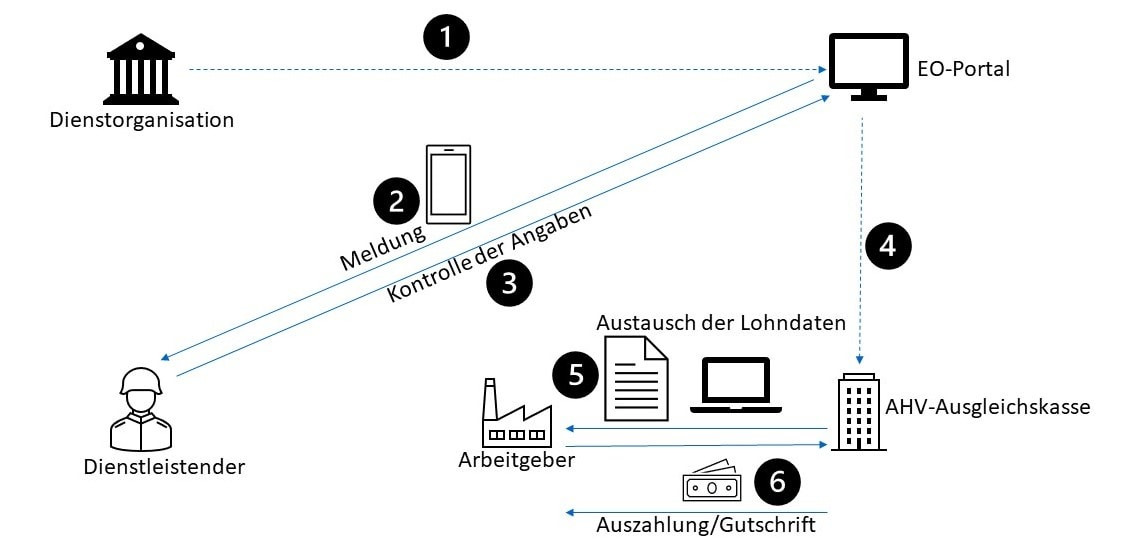
Figure 1 – Example process for an EO application by an employed person
- The service organisation reports the number of days of service to the new EO portal, which is set up and operated by the Central Compensation Office (ZAS).
- The EO portal informs the person performing the service (in standard cases by text message or e-mail, in exceptional cases by post) that an EO application is ready for processing. The application is supplemented with existing information from the social security systems, so that this does not have to be entered by the person performing the service, as is currently the case.
- The person performing the service accesses the EO portal, checks and confirms the information about their employment and marital status, and completes the existing data (e.g. regarding their employer). If the person performing the ser-vice encounters problems with the EO portal, they can contact the ZAS support organisation.
- The EO portal forwards the case to the relevant compensation fund.
- The compensation fund requests the relevant information from the employer for calculating and paying the loss of earnings. The employer reports the required data.
- The compensation fund calculates the loss of earnings and issues the credit note directly to the employer or the person performing military service.
The procedure differs slightly for other employment situations.
Key changes and benefits
Changes from the employer's perspective
The EO registration form containing details of the service organisation and per-sonal details of the service provider is sent directly to the relevant AHV com-pensation fund. The compensation fund obtains the necessary salary details di-rectly from the employer. This can be done in the following ways:
Letter with link/QR code: The employer receives a request by post to enter the wage data. The wage data can be entered directly online via a link/QR code, without a portal. If desired, the wage data can also be returned by post.
connect portal: In the compensation fund's connect portal, the request for wage data is transmitted digitally and the employer adds the relevant information.
Direct connection to ERP systems: A new Swissdec standard is used to transmit requests to the employer's ERP system (software for managing busi-ness processes, including payroll accounting). The employer approves the transmission of the required payroll data without manual entry in the ERP sys-tem, and the data is automatically transmitted to the implementing agency.
In a third step, the information on EO daily benefits is transmitted directly from the implementing agency to the employer's ERP system. In a third step, the in-formation on EO daily allowance benefits is transmitted directly from the imple-menting agency to the employer's ERP system.
This option is only available for appropriately equipped and certified ERP sys-tems. Swissdec is in contact with ERP system providers regarding the neces-sary enhancements.
Advantages of the new system
No need to request EO registration forms: With the new registration procedure, employers no longer need to request registration cards from their employees. This eliminates delays and additional work caused by lost or forgot-ten registration cards.
Potential for automation: Ideally, wage data is requested and transmitted automatically at the touch of a button, directly from the employer's ERP system. Thanks to automated transmission, there is also no need to enter the compen-sation for loss of earnings in the ERP system.
Qualitative advantages: The digitised process enables fast, efficient and high-quality processing (no need to type in data) and eliminates errors or misuse.
Timetable
The transition to the new procedure will take place gradually from 1 February 2026. The introduction will begin with the smallest service organisation, ‘Youth & Sport’, followed by the other organisations (civil defence, civil service, DDPS) in an order yet to be determined. For five years after the introduction, individual EO applications on paper from services performed before the switch to the new procedure may still be sent to employers. These will be processed as before.
Further information
Publicly available information:
AHV/IV Information Centre website
For further details or if you have any questions, please contact our compensa-tion office, Daily Allowances and Services Department, OASI, AI, APG, CM.